- English
- French
- German
- Portuguese
- Spanish
- Russian
- Japanese
- Korean
- Arabic
- Greek
- German
- Turkish
- Italian
- Danish
- Romanian
- Indonesian
- Czech
- Afrikaans
- Swedish
- Polish
- Basque
- Catalan
- Esperanto
- Hindi
- Lao
- Albanian
- Amharic
- Armenian
- Azerbaijani
- Belarusian
- Bengali
- Bosnian
- Bulgarian
- Cebuano
- Chichewa
- Corsican
- Croatian
- Dutch
- Estonian
- Filipino
- Finnish
- Frisian
- Galician
- Georgian
- Gujarati
- Haitian
- Hausa
- Hawaiian
- Hebrew
- Hmong
- Hungarian
- Icelandic
- Igbo
- Javanese
- Kannada
- Kazakh
- Khmer
- Kurdish
- Kyrgyz
- Latin
- Latvian
- Lithuanian
- Luxembou..
- Macedonian
- Malagasy
- Malay
- Malayalam
- Maltese
- Maori
- Marathi
- Mongolian
- Burmese
- Nepali
- Norwegian
- Pashto
- Persian
- Punjabi
- Serbian
- Sesotho
- Sinhala
- Slovak
- Slovenian
- Somali
- Samoan
- Scots Gaelic
- Shona
- Sindhi
- Sundanese
- Swahili
- Tajik
- Tamil
- Telugu
- Thai
- Ukrainian
- Urdu
- Uzbek
- Vietnamese
- Welsh
- Xhosa
- Yiddish
- Yoruba
- Zulu
Are black HDPE produce T-shirt bags recyclable?
Yes, black HDPE produce T-shirt bags https://www.lumingplastic.com/hdpe-t-shirt-bags/black-hdpe-produce-t-shirt-bagsare technically recyclable. They carry Resin Identification Code #2 (HDPE), which places them in the same recyclable category as milk jugs and detergent bottles. However, the carbon black pigment used to create their signature opacity creates a real challenge at Material Recovery Facilities (MRFs). Most automated near-infrared (NIR) sorting systems cannot detect black plastic film, causing these bags to bypass recycling streams and head to landfill. Understanding this distinction is essential for any B2B procurement strategy that includes sustainability reporting.
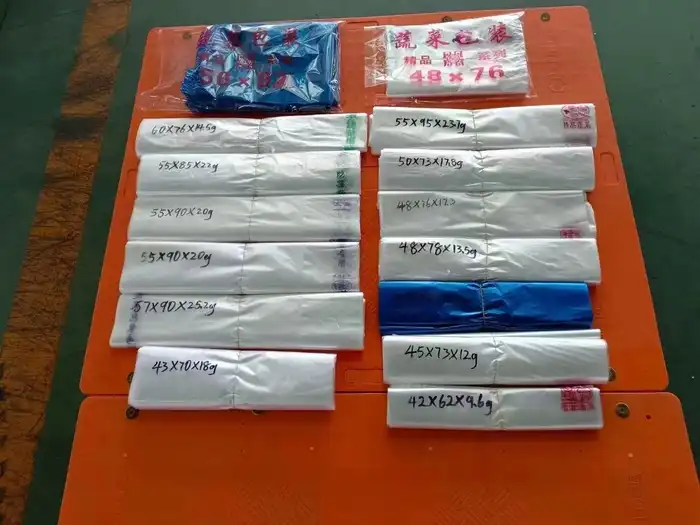
Understanding Black HDPE Produce T-Shirt Bags
What They Are and How They Are Made
These bags are produced by blowing virgin high-density polyethylene resin, density range 0.941–0.965 g/cm³. The ‘T-shirt’ or jacket handle design spreads the load stress over the entire bag body rather than only at two points. The film thickness is between 8 and 25 microns according on the application. The film is opaque throughout because the carbon black masterbatch is blended into the resin before extrusion.
Key Physical Properties
The bags are rigid because to the high crystallinity of HDPE. The black HDPE produce bag retains its shape when filled, unlike the soft, elastic LDPE bags, a crucial feature in a busy checkout or packaging line. They can contain between 5 kg and 35 kg per unit of weight, and they can endure temperatures from -50°C to +80°C, therefore they can be utilized in cold chain activities.
Why Buyers Choose the Black Film Variant?
The carbon black add-in does more than just color. It stops photodegradation that would weaken the polymer chains during storage or transport outside by blocking UV light. Root vegetables, like potatoes and ginger, directly benefit from this ability to block light, since darkness stops the growth of solanine and early sprouting. Industrial buyers also like the opacity because it hides grease marks on hardware parts, a benefit shared by black HDPE produce T-Shirt bags.
Are Black HDPE Produce T-Shirt Bags Recyclable?
The HDPE Recycling Process
HDPE film is typically recycled by collection at drop-off sites, bale sorting, shredding, washing and being made into pellets which are then blended with secondary resin. In 2018, the U.S. EPA reported 29.3% of HDPE containers were recycled. But plastic film, including bags, is constantly behind hard containers due to the flaws in the infrastructure. Most curbside systems do not accept plastic film at all, and the easiest method for customers to get their garbage picked up is still to drop it off at a store.
The Black Pigment Problem
Most MRFs nowadays are built around NIR sorting technology, which shines light on plastic film and reads the light that bounces back to determine the type of polymer it is. The sensor can't see through black plastic since it blocks practically all NIR wavelengths instead of returning them. In a 2020 report, WRAP (Waste & Resources Action Program) said black plastic packaging is often misidentified or missed by automatic sorting systems. Thus, black HDPE bags, which are legally recyclable, frequently find their way into the trash streams that already exist.
Comparing Environmental Footprints
The International Journal of Life Cycle Assessment study indicated that each time an HDPE bag is reused at least twice, it has less carbon impact than a paper bag. The compostable solutions have their perks and cons. They require industrial composting equipment and generally can't hold more than 10 kg before breaking. When it comes to heavy-duty purchasing needs like trash management, food service back-of-house, or wholesale produce, black HDPE is still the best choice, as long as sensible end-of-life planning is done.
Comparing Black HDPE Produce Bags with Alternatives
Black HDPE vs. White HDPE
Black and white HDPE bags are made of the same chemical makeup; the main difference is how easily they can be recycled. White and natural-colored HDPE film correctly reflects NIR wavelengths, which lets MRF sorters find it and send it to the right place. If reporting on sustainability is important to you and your application doesn't need UV blocking or opacity, white HDPE is easier to recycle. When light defense is necessary, like for keeping food fresh, industrial parts, or trash cans, black HDPE produce T-Shirt bags are the right choice.
Black HDPE vs. Paper and Compostable Bags
The black and white HDPE bags are chemically identical. The difference is the ease of recycling. White and natural colored HDPE film correctly reflects NIR wavelengths, allowing MRF sorters to find it and send it to the right place. If you care about sustainability reporting and don’t need UV blocking or opacity, white HDPE is the easiest to recycle. Black HDPE production T-Shirt bags are the best solution for light defense like keeping food fresh, industrial parts or trash cans.
Best Practices for Procurement and Disposal
Verifying Supplier Credentials
To get site teams to follow these basic disposal rules, procurement managers should tell them:
- Store-drop-off programs: Direct facility staff to consolidate used black HDPE bags for drop-off at participating retail locations rather than placing them in curbside bins, where they contaminate other recycling streams.
- Back-haul return programs: Negotiate with your supplier or distributor to accept returned clean bag material for closed-loop recycling, a model already operating in several European grocery chains.
- Energy recovery as a last resort: Where mechanical recycling is unavailable, waste-to-energy facilities can recover the calorific value of HDPE film without generating the toxic residues associated with PVC or mixed plastics.
When these practices are built into deals with suppliers and staff training, procurement teams can include black HDPE produce T-Shirt bags in ESG reports under the categories for reusable materials with proof that they are legal.
OEM and Custom Specification Options
When buyers work directly with manufacturers, they can change the film gage, handle geometry, and melt flow index to fit their filling equipment. Direct factory supply gets rid of markups on the middlemen and makes sure that specifications stay the same for big orders.
Key Considerations for B2B Buyers
Evaluating Supplier Credibility
Before choosing a provider, make sure you get quality management documents that are equal to ISO 9001 and food-grade compliance certificates. Instead of depending only on self-reported specifications, look at test results from a third party. Client references from businesses that buy about the same amount of goods can show that a supplier is reliable.
Pricing, MOQ, and Logistics
When purchased in large quantities, black HDPE produce bags are usually paid by weight (per ton) rather than unit. Buyers who have more than one plant location can save time and money by combining SKUs into a single standard. This simplifies the inventory and lowers the cost per unit. Luming Plastic has a production facility in Rizhao that is 16,500 m² and has direct access to National Highway G206 and Rizhao Port. This means that stock orders can be shipped the same day, and standard custom runs can be finished in 3–5 days.
Sustainability Trends Shaping Future Procurement
Extended producer responsibility (EPR) frameworks are being worked on by regulators in California and the EU. These will require importers and retailers to pay for infrastructure for collecting plastic film. When writing procurement policies today, they should take into account how likely it is that within the next five years, black pigment limits or NIR-detectable carbon black substitutes will become procurement standards. Long-term compliance will be better with suppliers who invest in detectable black pigment alternatives, such as carbon black alternatives that reflect NIR.
Conclusion
The carbon black pigment in Black HDPE produce T-Shirt bags absorbs NIR light, making them difficult to sort through automatically. For business-to-business buyers, the best thing to do is not to avoid them—their performance benefits in load capacity, UV protection, and cold-chain durability are hard to match—but to buy them from suppliers with clear disposal protocols and quality documentation that can be checked. By knowing where the recycling system is lacking right now, procurement teams can write accurate ESG stories instead of making claims about how easy it is to recycle.
FAQ
Can black HDPE bags go in curbside recycling bins?
In general, no. Most curbside services in the U.S. don't accept any kind of plastic film, no matter what color it is. Under the How2Recycle #2 program, black HDPE bags should be taken to stores that have drop-off spots for plastic film. Putting them in bins at the curb can make paper and rigid plastic bales dirty.
Does the black pigment make these bags unsafe for food contact?
Not if the company uses food-grade carbon black masterbatch that is approved by the FDA. The formulations used by Luming Plastic are in line with FDA 21 CFR 177.1520 and EU Regulation 10/2011. This means that no harmful chemicals get into packaged food or produce.
Why can't NIR sorters detect black plastic?
NIR sensors look at the spectra of reflected light to find polymers. Carbon black soaks up almost all NIR light (900–1700 nm), so the sensor doesn't have any information to work with. This is a problem with the sorting system, not a flaw in the product itself.
What load capacity do these bags support?
Load capacity runs from 5 kg to 35 kg per unit, depending on the thickness of the film and the size of the bag.
Are there NIR-detectable black bag alternatives?
Yes. Some companies now make black bags with non-carbon dyes or laser-detectable ingredients that let NIR sorting happen. These are new options that should be kept an eye on for procurement policies that aim to be EPR-compliant after 2026.
Get a Custom Quote on Black HDPE Produce T-Shirt Bags from Luming Plastic
For businesses that require verified load performance, food-grade compliance, and reliable bulk supply, Luming Plastic manufactures black HDPE produce T-Shirt bags. We offer free samples within 24 hours, a flexible MOQ starting at 5,000 pieces, and same-day shipping on stock orders as a direct black HDPE manufacturer of T Shirt bags with 30 years of production experience. To get prices and specs, email our team at sales@lumingplastic.com.
References
1. U.S. Environmental Protection Agency. Advancing Sustainable Materials Management: 2018 Fact Sheet. EPA, 2020.
2. WRAP (Waste & Resources Action Programme). Halving Waste to Landfill: Black Plastic Packaging. WRAP, 2020.
3. Harding, K. G., Dennis, J. S., von Blottnitz, H., & Harrison, S. T. L. "Environmental Analysis of Plastic Production Processes." The International Journal of Life Cycle Assessment, 2007.
4. Franklin Associates. Life Cycle Inventory of Polyethylene: High-Density, Low-Density, and Linear Low-Density. Prairie Village, KS: Franklin Associates, 2011.
5. American Chemistry Council. 2022 United States National Postconsumer Plastic Bag & Film Recycling Report. ACC, 2023.
6. European Commission. Packaging and Packaging Waste Directive: Revised Targets and Recyclability Criteria. Official Journal of the European Union, 2022.
Get customized packaging solutions with fast professional support.